
Why Cyclists Are Invisible to Drivers — And What You Can Do About It

Every rider has felt it … that stomach-dropping moment when a car cuts across your path, the driver glancing up with a startled look that says one thing: *I didn’t see you.*
That moment isn’t just frightening. For thousands of cyclists every year, it’s fatal.
The Invisible Cyclist Problem Is Real
According to the National Highway Traffic Safety Administration (NHTSA), over 1,100 cyclists were killed and nearly 50,000 injured in U.S. traffic crashes in a single recent year. More alarming is *why* these crashes happen. Research involving 1,460 drivers and cyclists found that a large proportion of cyclist-vehicle crashes were caused by drivers simply not seeing the cyclist in time to avoid a collision — what researchers call “looked-but-failed-to-see” crashes.
This isn’t just driver negligence. It’s a documented psychological phenomenon called **inattentional blindness**. Drivers scan the road for cars. Their brains are trained to filter out smaller, unexpected objects. A cyclist, even one riding in plain sight, can be mentally edited out of a driver’s visual field entirely.
Making it worse: nearly 80% of cyclist collisions happen in **broad daylight** — not at night as most people assume. And studies show cyclists dramatically overestimate how visible they are to drivers, believing drivers can spot them from twice the distance drivers themselves report.
The Math of Being Seen
A 2009 study published in Accident Analysis & Prevention found that cyclists estimated drivers would recognize them from roughly twice the distance that drivers themselves reported. In other words, you think you’re visible. You’re not.
Fluorescent and brightly coloured clothing has been shown to improve detection time — drivers spot high-visibility colours sooner and from a greater distance. But visibility isn’t just about colour. It’s about movement patterns and retroreflection. Research from Queensland University of Technology found that drivers are more likely to recognize a human presence when they can see movement patterns associated with cycling — which is why reflective logos on moving parts of your body and gear make a significant difference at night.
What Actually Helps
**Rear reflective markings** that catch headlights — especially effective at dawn and dusk when glare impairs driver vision
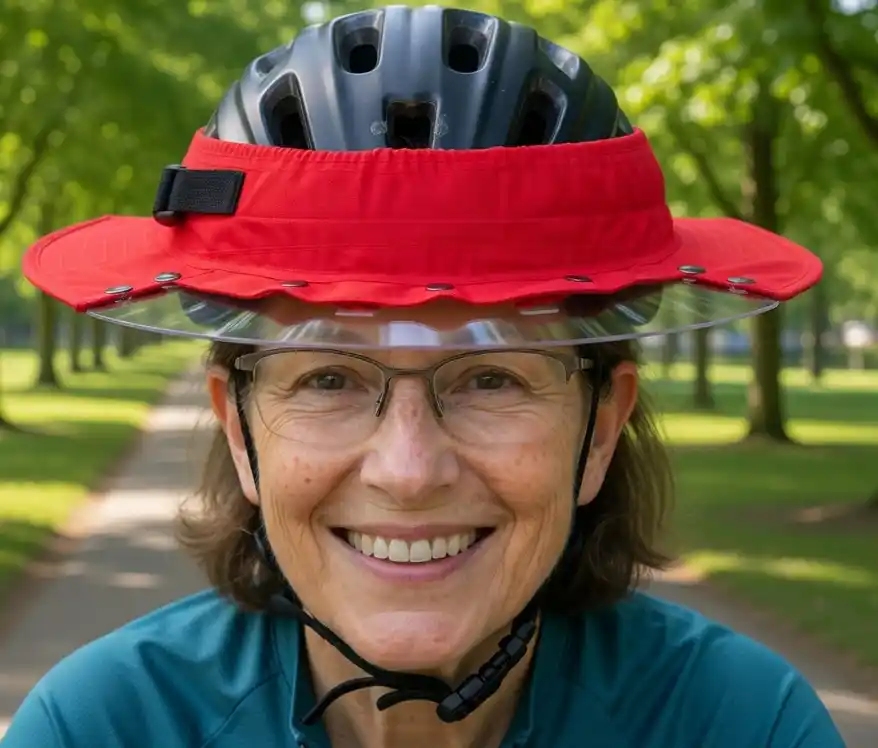
**Wide, coloured brims** that make your profile more recognizable as a human rather than an anonymous shape
**High-contrast gear** that stands out against both light and dark road backgrounds
The ShadyRider was built with exactly this in mind. Its wide brim and its bold colour options — red, green, sky blue, grey, pink, and black — create a distinct visual profile that registers as human. Its rear reflective logo is positioned to catch night riding car headlights directly. On a road where your life depends on being seen, being forgettable is not an option.
The Bottom Line
If you’re riding without any rear visibility aid, drivers behind you are relying entirely on your clothing and their own attention — two things proven to be unreliable. Adding rear reflectivity to your ride is one of the simplest, most evidence-backed things you can do to protect yourself on the road.
*The ShadyRider slips onto your existing helmet in seconds and puts a rear reflective logo right where drivers’ headlights will find it. No tools. No complicated setup. Just ride safer.*